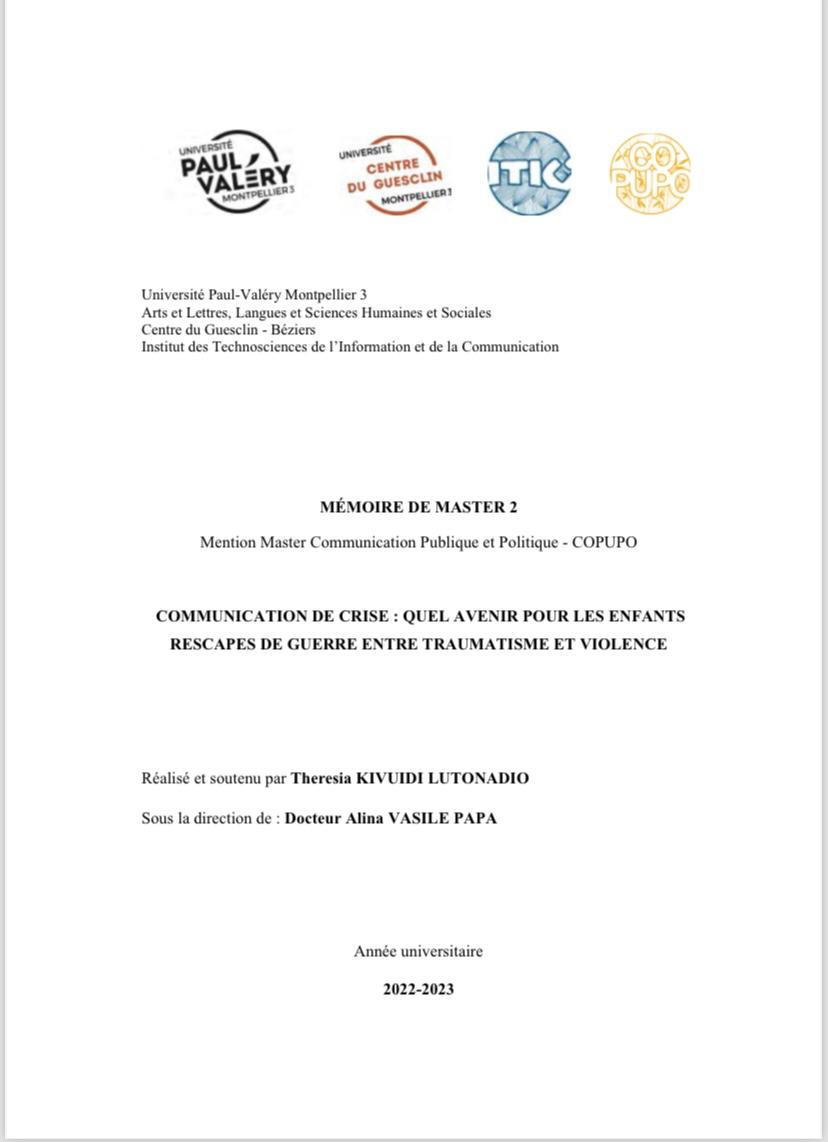
Crisis communication: what future for child survivors of war, between trauma and violence?
Context
This thesis sits within the field of crisis communication and armed conflict studies, focusing on the effects of war on children in eastern Democratic Republic of Congo, a region marked for more than two decades by persistent armed conflict, mass population displacement, and severe psychological and social trauma.
The research question: how do humanitarian organisations use crisis communication strategies to support children affected by armed conflict and contribute to their psychological and social recovery?
My role
Author of the thesis, written and defended under the supervision of Dr Alina Vasile Papa, academic year 2022-2023.
My main contributions
Analysing the role of leading humanitarian organisations
The study focuses in particular on two organisations working in the Great Lakes region.
- The United Nations High Commissioner for Refugees (UNHCR)
- The Panzi Foundation, dedicated to supporting survivors of violence
A qualitative methodology
- Analysis of documents and reports from international organisations
- Study of survivor testimonies
- Study of communication and intervention strategies deployed in the field
Formulating recommendations
- Strengthening coordination between international actors to protect children affected by war
- Deepening reflection on civilian populations' resilience mechanisms in the face of prolonged crises
The essentials
- Population reached
- Child survivors of war, Great Lakes region (eastern DRC)
- Key skills
- Qualitative research, document analysis, crisis communication
- Organisations studied
- UNHCR, Panzi Foundation
- Impact
- Contributing to thinking on the protection and support of children affected by war
Results
Crisis communication plays a central role in managing complex humanitarian situations: it does more than inform or mobilise international actors, it also contributes to a process of rebuilding, restoring visibility and a form of dignity to affected people.
The analysis also highlights the limits of these efforts: humanitarian organisations operate under political, security and financial constraints that sometimes reduce the reach of their interventions.
- Completed a research thesis in public and political communication
- Developed recommendations on strengthening humanitarian coordination
Skills mobilised
What this experience taught me
This research confirmed my interest in peace, child protection and international cooperation, which continue to guide my professional path today. It also taught me that analysing a crisis means understanding its limits as much as its mechanisms, and that there is no rebuilding without coordination between actors.